SHIMANO FD-TY15SS Tourney Front Derailleur Triple Singapore 28.6MM
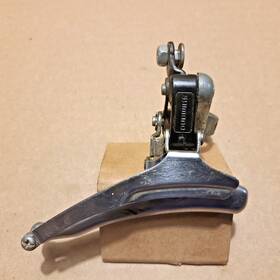
( Brand: Shimano ), ( Manufacturer Part Number: FD-TY15SS ), ( Part Type: Derailleur ), ( Compatible Brand: For Shimano ), ( Color: Silver ), ( Material: Aluminum ), ( Mounting Type: Clamp-on ), ( Cable Pull Type: Bottom Pull ), ( Compatible Bike Type: Mountain Bike ), ( Number Of Chainrings: Triple ), ( Item Weight: 100-199 G ), ( Item Width: 28.6 Mm ), ( Country Of Origin: Singapore )
Review SHIMANO Vintage Tourney Front Derailleur Triple 28.6mm Singapore
The **Shimano FD-TY15SS 1994 Tourney Front Derailleur (Triple, 28.6mm)** is a classic, no-frills component from Shimano s entry-level Tourney series, designed for budget-conscious cyclists seeking reliable performance without the complexity of higher-end systems. This front derailleur, originally manufactured in Singapore, embodies the utilitarian engineering of the early 1990s, offering a straightforward solution for shifting between three chainrings a common setup on mid-range road bikes of the era. The **28.6mm axle width** is a hallmark of Shimano s Tourney components, striking a balance between durability and weight, ensuring smooth operation while maintaining a compact footprint that avoids interference with frame or fork elements. Constructed from durable steel, the derailleur features a robust **pivot system** with a single large pulley and a smaller, secondary pulley designed to guide the chain efficiently across the chainrings, minimizing chain slap and wear. The **triple-range configuration** (typically paired with a 44/34/24 or 46/36/26 tooth setup) caters to riders who prioritize versatility over extreme gearing, making it ideal for commuting, casual riding, or light touring where shifting consistency is more critical than aggressive climbing ratios.
The **1994 model year** reflects Shimano s focus on refining ergonomics and shifting precision during this period, with the FD-TY15SS incorporating a **spring-loaded return mechanism** that ensures the derailleur resets smoothly after each shift, reducing the effort required to engage the next gear. The **indexing system**, while not as refined as later Shimano models, is designed to work seamlessly with the **Tourney STI shifters** (or compatible alternatives) of the time, delivering predictable shifts with minimal drift, a testament to Shimano s commitment to reliability in their entry-level offerings. The **Singapore manufacturing** tag underscores its global accessibility, as Shimano s production facilities in the region were known for producing high-quality, cost-effective components for international markets. Though not equipped with modern features like micro-adjust or electronic shifting, the FD-TY15SS remains a functional and nostalgic piece, appealing to collectors, restorers, and enthusiasts who appreciate the simplicity and durability of vintage Shimano gear.
For the modern rider or restorer, this derailleur presents a unique opportunity to revive a piece of cycling history while benefiting from its time-tested reliability. Its **steel construction** ensures longevity, though it may require occasional lubrication to maintain smooth operation, especially in environments with dust or moisture. The **28.6mm axle** remains a standard for many vintage frames, making it a versatile upgrade for bikes from the late 1980s to the mid-1990s. While it lacks the precision tuning of contemporary derailleurs, the FD-TY15SS excels in its simplicity no complex adjustments, no electronic dependencies, just a dependable mechanical system that shifts when needed. Whether integrated into a restored Tourney-equipped road bike or repurposed for a project bike, this derailleur stands as a reminder of Shimano s legacy in making cycling accessible to riders of all levels, all while carrying the distinct charm of a well-worn, well-loved component from another era.
The Shimano FD-TY15SS Tourney front derailleur from 1994 is an older, budget-oriented component designed for entry-level road bikes. Below is a detailed breakdown of its pros and cons, followed by a conclusion and recommendation.
---
**Pros:**1. **Affordability** This derailleur was originally priced for budget-conscious cyclists, making it a cost-effective option for those on a tight budget or rebuilding an older bike. Even used, it remains inexpensive compared to modern alternatives.
2. **Simplicity and Reliability** The Tourney series was built for basic functionality, with straightforward mechanics that are less prone to complex failures. For casual riders or those who don t ride frequently, this can translate to lower maintenance needs and fewer issues.
3. **Compatibility** As a 28.6mm (1.125-inch) derailleur, it fits standard road bike frames and forks designed for older Shimano or non-SLX/SLX-Freehub systems. It works with triple cranksets (e.g., Shimano Tourney, Deore, or older 2x/3x setups) and is compatible with most chainrings from that era.
4. **Durability for Its Class** While not built for heavy use or aggressive riding, the Tourney series was designed to last for basic commuting or light recreational riding. The materials and build quality are adequate for casual use, though they are not as robust as higher-end derailleurs.
5. **Availability of Parts** Since it s an older model, replacement parts (e.g., pulleys, springs, or hanger bolts) are still relatively easy to find, especially in Asia or among vintage bike shops. This can be useful for minor repairs or upgrades.
6. **Lightweight for Its Era** Compared to derailleurs from the 1980s, the FD-TY15SS is relatively lightweight, which can be a minor advantage for riders who prioritize weight savings in older bikes.
7. **No Advanced Features** It lacks modern complexities like electronic shifting or advanced indexing systems, which can make it easier to maintain or replace if you prefer simplicity.
---
**Cons:**1. **Outdated Design** The derailleur is nearly 30 years old, meaning it lacks modern refinements in shifting smoothness, efficiency, and durability. The pulley design, cage geometry, and spring tension are not optimized for today s standards, which can result in less precise shifting and more wear over time.
2. **Poor Shifting Performance** The Tourney series was never known for smooth or consistent shifting. The derailleur may exhibit chain skips, misalignment, or difficulty indexing between gears, especially if the bike is ridden regularly or in wet conditions. This can be frustrating for riders who expect modern shifting standards.
3. **Limited Lifespan** The materials used in the 1990s, such as the cage material and bearings, are not as durable as those in modern derailleurs. Rust, wear, and eventual failure are more likely, particularly if the derailleur is exposed to moisture or heavy use. The spring can weaken over time, leading to inconsistent shifting.
4. **Incompatibility with Modern Components** While it fits older setups, it may not work well with modern chains, cassettes, or cranksets designed for wider spacing or lighter materials. Mixing it with newer components can lead to poor shifting or accelerated wear.
5. **No Adjustability for Modern Needs** The derailleur lacks features like quick-release cage bolts or adjustable limit screws that are standard in modern derailleurs. Fine-tuning the shift alignment or tension can be more difficult, and the cage may not align properly with modern chainrings or cranks.
6. **Rust and Corrosion** Older derailleurs are more susceptible to rust, especially if stored in damp environments. Even if the derailleur looks clean, internal components may be corroded, leading to stiffness or failure.
7. **Limited Aftermarket Support** While parts may still exist, finding a replacement derailleur or upgrading to a newer model may require sourcing from vintage shops or international sellers. Modern Shimano derailleurs (e.g., Tourney, Deore, or higher) offer better performance and are more widely available.
8. **Safety Concerns** If the derailleur is worn or damaged, it could fail catastrophically during riding, posing a risk. Older derailleurs are less likely to have safety features like cage stops or reinforced pulleys found in modern designs.
---
**Conclusion:**The Shimano FD-TY15SS Tourney front derailleur is a functional but outdated component best suited for very low-budget projects, restoration of vintage bikes, or as a temporary replacement. It excels in affordability and simplicity but falls short in performance, durability, and compatibility with modern cycling demands. For casual riders or those working on a classic bike as a hobby, it may serve its purpose without significant issues. However, for anyone expecting smooth shifting, reliability, or the ability to mix it with newer components, a modern derailleur (e.g., Shimano Tourney FD-TY3000 or higher) would be a far superior choice.
---
**Recommendation:**- **Use it if:** You are restoring a 1990s-era bike for nostalgic or budget reasons, and the derailleur is in good condition. It s also a viable option if you re building a very low-cost bike for occasional use where performance is not a priority.
- **Replace it if:** You plan to ride the bike regularly, mix it with modern components, or prioritize smooth shifting and durability. Invest in a newer Shimano Tourney (e.g., FD-TY3000 or FD-TY5000) or a higher-end derailleur like Deore (FD-M3100) for better performance. If the derailleur shows signs of rust, wear, or poor shifting, replacing it is the safer and more practical choice.
- **Alternative:** If you re working with a tight budget but want better performance, consider a used or refurbished Shimano Tourney derailleur from the 2000s or later, which will offer improved shifting and longevity.
Details:
Vintage 1994 Shimano Tourney Front Derailleur FD-TY15SS Triple 28.6mm Singapore, Used: cosmetic wear, light rust, Please feel free to send offers or questions.
part #: fdty15ss prices
- $14.29-$40.00
specifications ribicycl:
- brand: Shimano
- mpn: Fd-ty15ss
- part type: Derailleur
- compatible brand: For Shimano
- color: Silver
- material: Aluminum
- mounting type: Clamp-on
- cable pull type: Bottom Pull
- compatible bike type: Mountain Bike
- number of chainrings: Triple
- item weight: 100-199 G
- item width: 28.6 Mm
- country of origin: Singapore
returns ribicycl:
- policy: No Returns
payments ribicycl:
- credit card: Mastercard
- other
- wallet: Paypal
shipping ribicycl:
- class: Standard, Expedited
- service: USPS Ground Advantage, USPS Priority Mail Padded Flat Rate Envelope
- transit: 10-13 Days
- carrier: USPS
- type: Calculated
- cost: $6.72
general ribicycl:
- Cycling > Bicycle Components Parts > Front Derailleurs
- condition: Used
offer ribicycl:
- availability: In Stock
- quantity: 1
- sold: 0
- options: Ship-to-home
- started: May 29, 2026
- best offers: True
seller ribicycl:
- city: Belgrade, Maine
- rating: 100.0%
- # reviews: 222
Shimano FD-TY15SS Is Similar To:
- 105 1056 Shimano Brake Caliper Front Recessed Mm Reach (38.5% similar) Light scratches and some wear functions properly. Shimano 105 brake caliper br front only reach good condition. Springs are strong everything is intact check pics for condition thanks...(October 25th, 2018)
- 105 Rd-1050 Shimano Rear Derailleur Sis Sti Shifting (42.7% similar) E-mail with any questions. Specifications: six speed slant parallelogram rear derailleur for sis sit friction shifting. Total weight 257 grams. 28T max cog, alloy body and cage. Condition: used but excellent condition. Shipping calculated for all destinations. Please see my other offers for more ...(August 19th, 2018)
- 1055 Shimano Vintage 105 Group (40.4% similar) This is a vintage Shimano 105 group 5MM, bottom bracket, derailleurs braze-on front down tube shift levers friction or index hub and pedals with integrated toe clips. Shipping is 35 in the us. All in very nice condition. Brakes, levers, cranks 53-42T, 172...(January 1st, 2018)
- 106-476-ifdmc18ebtm6 Shimano Front Derailleur (38.7% similar) Product ships through USPS or ups ground. For any other reason: you can return the product reason, as long it is in original condition when was purchased, with packaging. CY87 mountain time. Mountain time ship same day. You see, we love to ride bikes too, and think that everyone should with us. ...(March 17th, 2018)
- 13e90002057 Shimano Ultegra Long Cage Road Bike Rear Derailleur Oe (42.8% similar) The lightest scuffs shown in picture from storage. Never installed on a bike...(December 30th, 2018)
- 140779 Shimano Altus Mountain Bike Rear Derailleur Direct Mount 689228130913 (42.6% similar) ...(June 10th, 2018)
- 1fdr443f Shimano Front Derailleur Silver (47.1% similar) 9-SPEED bottom pull cable max capacity: 10T material: aluminum type: clamp-on 28. Shimano parts take you the distance. Brand new adhesive n box Shimano parts have you covered...(March 16th, 2018)
- 200gs Fc-m201 Shimano Vintage Bicycle Sg Tooth Biopace Crankset (33.8% similar) Domestic: shipping USPS priority mail and parcel post with delivery confirmation, larger than oversize packages are shipped ups. Shimano sag b tooth steel rings. We respect your privacy. For a combined shipping quote please or request the total. Vintage Shimano 200GS bicycle 170MM sag b tooth bio ...(February 16th, 2019)
- 43224-17105 Yad Shimano Rear Derailleur Speed Direct Mount For 695642259321 (33.8% similar) The bicycle parts are important, Shimano brand will brings you unusual experience. A: yes does the derailleur come bolt to attach it bicycle frame...(August 5th, 2018)
- 600ex Shimano Rear Derailleur Model (42.1% similar) Brand new in the box...(August 25th, 2018)
- 657552851347 Shimano Road Bike Derailleur Shift Cable Set Stainless (42.5% similar) Shimano road bike derailleur shift cable set stainless steel black SP41 housing details unsealed end caps and sleeves SIS40 outer casing non coated inner wire wire: 2 piece: 1,2MM x 2100MM original gear with casing. Shimano road bike derailleur shift cable set stainless steel black SP41 housing. The...(August 4th, 2018)